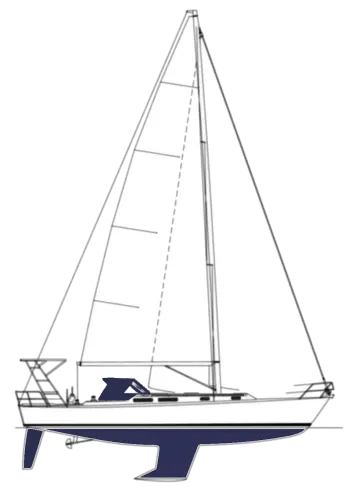
I had a few missions to accomplish in La Paz. Stocking up on fuel and provisions was only the first step. The transmission on s/v Wild had been acting up and I wanted to get a mechanic to look at it. The hydraulic backstay adjuster had also leaked fluid during summer storage and probably needed new seals, so I wanted to find a hydraulic shop to overhaul it. And as long as I was there, I found a dentist for a check-up.
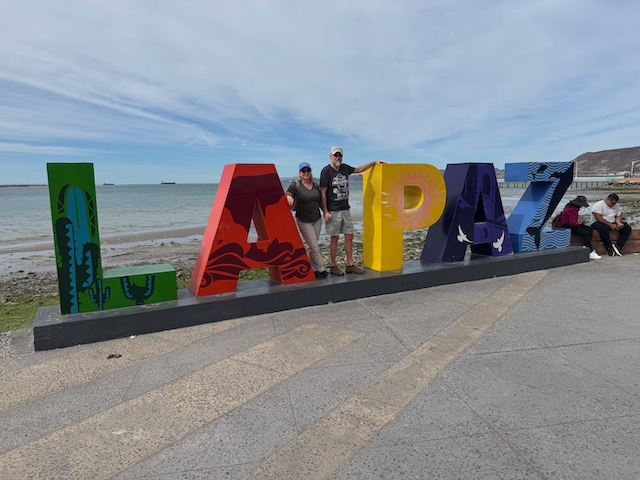
Well, things weren’t as easy as all that. There was a several week wait to see a mechanic. And parts would have to be ordered in from the US, which took quite a long time.
Had a pretty relaxed New Years Eve at Club Cruceros. Since sailors go by Universal Time, midnight (GMT) on the west coast falls at 1700. Conveniently at happy hour!
Then, instead of swinging on anchor in the harbor for a month, I headed back north for some lazy days in the islands.
There was a nice 12-20 knot wind blowing from the west, so we had an idyllic broad reach 50 nautical miles up to Isla San Francisco. Oddly, hardly any other boats were sailing. The ones I saw (and passed) were mostly motoring along on the panga highway. Credit-card captains on vacation charters, I suppose. Oh well, their loss.
Well, it was almost idyllic. As we passed a gap in the peninsular mountains, the wind gusted up from 15 to 30 knots in seconds, and a bit of chaos ensued. One of the (now empty) kayak brackets must have caught a flailing jib sheet and disappeared overboard. And one of the battens in the stack pack burst through its pocket and jumped overboard. Yeah, you’re supposed to roll up and secure the sail cover when underway, but we get lazy. D’Oh!
And there was this odd odor like some kind of tar… Well I didn’t track that down right away, but later I discovered that it was the pressure switch on the fresh water pump melting down. So no pressurized (or hot) water for the rest of the month – just cold water run through the foot pump.
But as we arrived in the oval bay at Isla San Franscisquito, I saw that my problems were small compared to these guys:
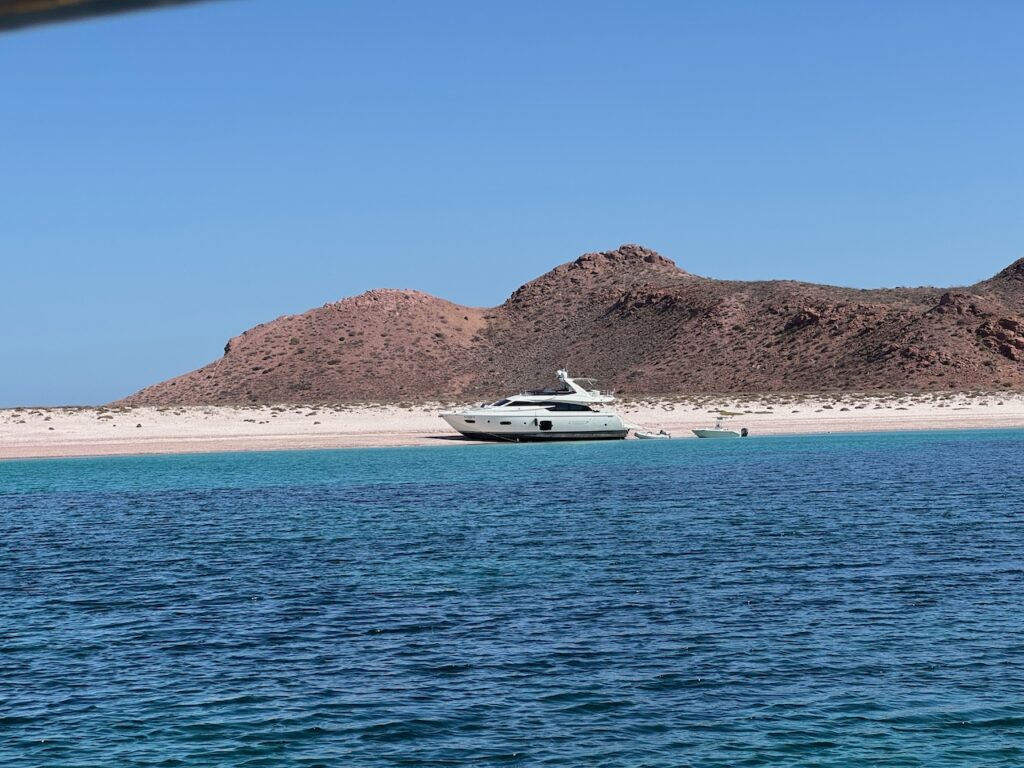
A big motor yacht, high and dry on the beach. More credit-card captains. Yes, there was a well-forecast westerly blow the night before, which makes this particular anchorage uncomfortable and a lee shore. The Coromuel Winds that everybody around here knows about. And apparently these guys had no idea how to anchor properly. All the other boats had gone over to the other side of the island for the night, but these guys ended up on the beach. And provided some schadenfreude-style entertainment for the rest of the week. They came out in their dinghy to borrow my internet connection to call the charter base and I couldn’t help overhearing some things. So I went below to fix dinner and turned up the stereo so I wouldn’t hear any more.
The charter base sent out that little runabout that ridiculously tried to pull the big boat off the beach for a couple of days. Then another big motor yacht tried to pull them off, but of course they didn’t have a big tow hawser on board (nor did any of us) and all they did was snap a lot of dock lines trying. They did finally get off on a high tide later in the week. I was amazed that their propellers weren’t wrecked, but they motored off under their own power.
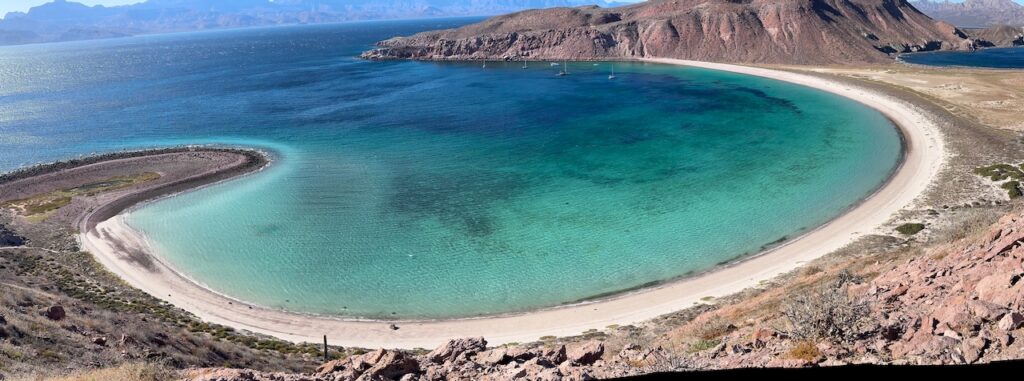
Again, not the first time Wild has been here, but the first relevant blog entry. (Again, we’re starting in the middle.) So, this is the picture post-card circular anchorage that you’ll see in every single YouTube about Baja. Just far enough away from La Paz to eliminate the day-trippers. The bottom is sand with patches of kelp. (Don’t drop your anchor in the kelp or you’ll be sorry!) Sea turtles lazily graze on the vegetation. Dolphins troll around. Clouds of smaller fish hide in the shadows of the boats. Flocks of pelicans dive crazily after them. Even though this place is usually crowded with boats, it’s usually worth stopping.
Above, you can see that all of the boats are huddled together, trying to stay in the lee of the northern cliff. Big northerlies blew through for a few days.
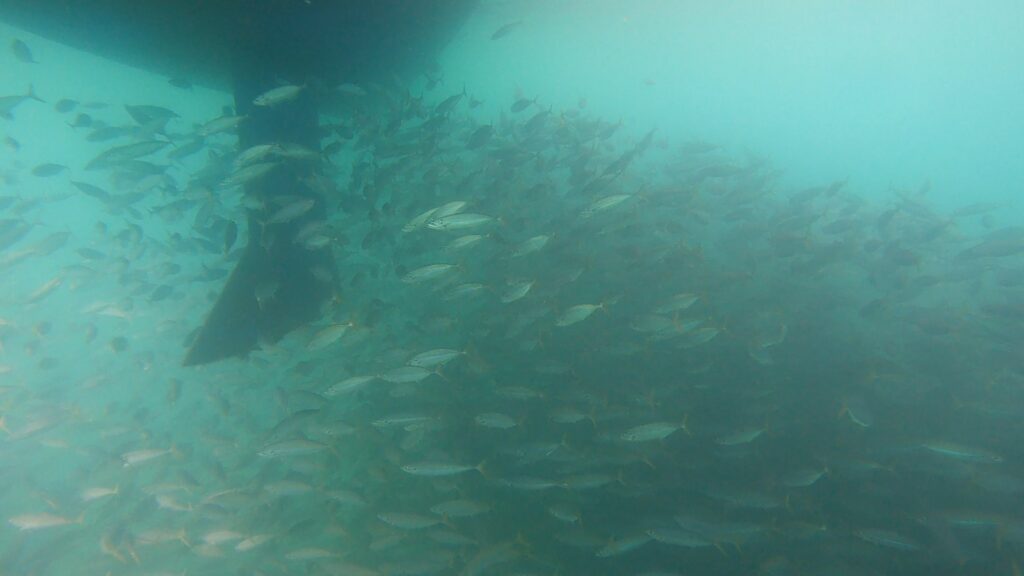
Fish hiding in the shadow of the boat.
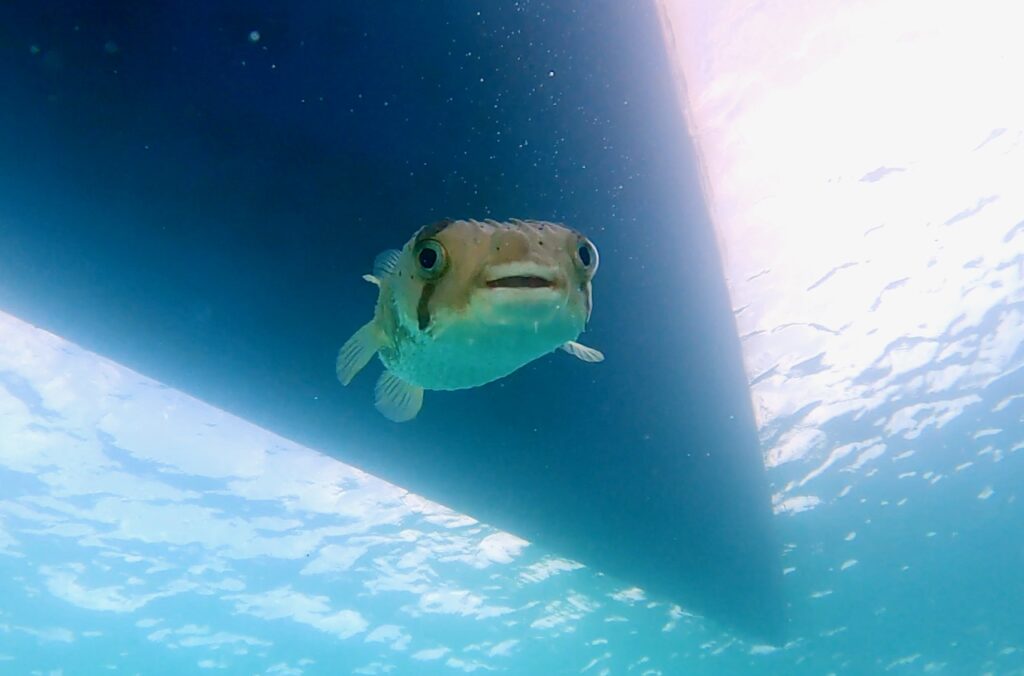
This one seems happy to see us.
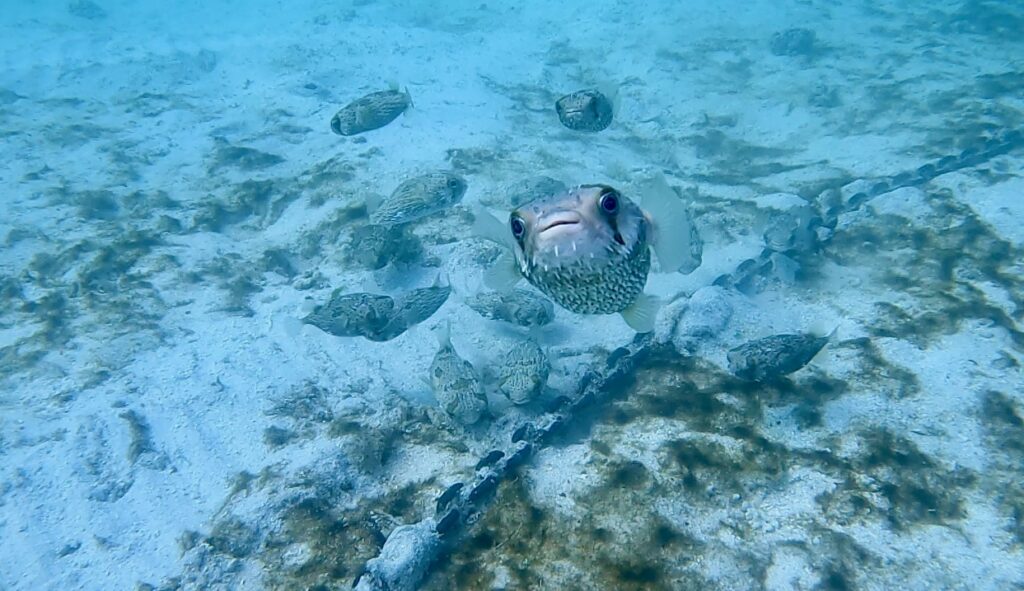
Wherever we anchor on a sandy bottom, a group of puffer fish gathers around where the anchor chain meets the sand. I guess the small movements of the chain dig up something they think is tasty. Sometimes small stingrays join in.
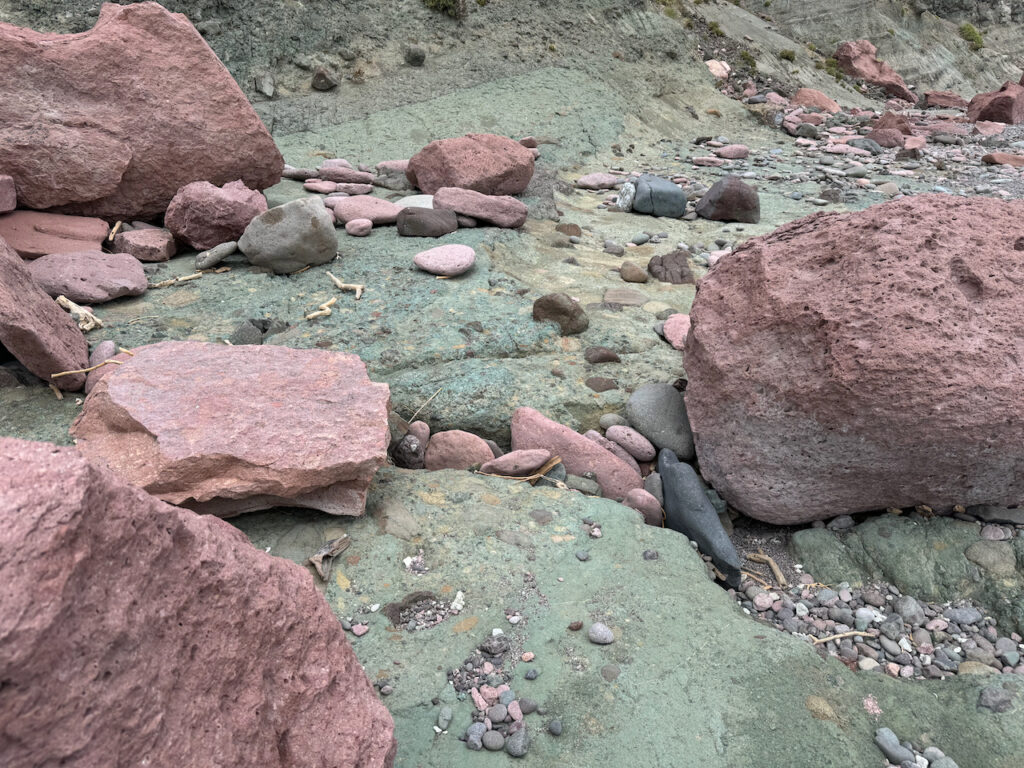
Ashore, the island is composed of basalt and volcanic tuff. Brilliant shades of green and hot pink rocks. It seems odd to me that most people never go beyond the beach.
There are two principal hiking trails on the island. One follows the ridgeline above the circular bay and provides great views of the anchorage. The other climbs to the summit of the island, to the north, and provides sweeping views of the San Jose Channel. In this season (and ongoing drought) most of the vegetation appeared dry and lifeless. Except a few tiny blossoms and fruits almost hidden among the dry twigs. One has to look closely to find some of these signs of life.